The word “neurodivergent” is having a cultural moment. Elon Musk invokes it to describe his autism. Nicki Minaj recently used it on social media to align herself with Musk’s vision of neurodivergent people as a vanguard of intellectual and economic power. Alex Karp, CEO of Palantir, declared that “the future is neurodivergent.”
These are not fringe statements. They reflect a growing trend in which “neurodivergent” is being redefined, quietly but consequentially, to mean something narrower than it was ever intended to be.
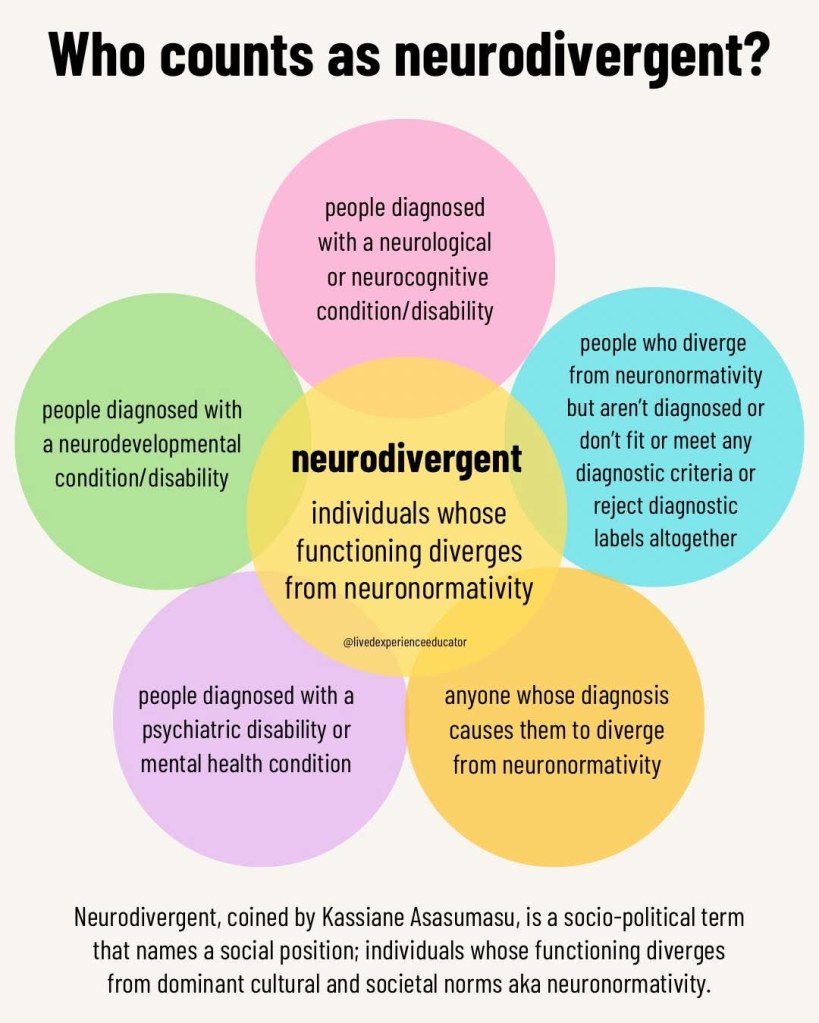
Kassiane Asasumasu, the disability advocate widely credited with coining the term in the late 1990s, was explicit about her intent: the word was designed as a tool for political coalition-building, to unite people with a wide range of neurological and mental health differences under a single banner. “There is not a list of qualifying conditions,” she told The 19th News this month. “There will never be a list of qualifying conditions. However big you think it is, bigger than that.” https://19thnews.org/2026/03/nicki-minaj-neurodivergent-trump-musk-politics/
What is circulating in popular culture and right-wing political spaces is not that term. The version gaining traction there is something different: a narrow category reserved for people whose cognitive differences are economically legible; hyperfocus, technical mastery, pattern recognition. People who, as one researcher put it, can be “harnessed” for productive ends. Intellectual disability, mental illness, and anything that requires substantial daily support are quietly excluded from this framing.
This distinction is not semantic. It has direct consequences for who gets counted, who gets funded, and who gets housed.
At NeuroHomes Communities, we work with and for the people this cultural redefinition leaves out. The neurodivergent adults most likely to experience housing instability are not the ones being celebrated in tech keynotes. They are people with complex support needs, co-occurring conditions, trauma histories, and economic marginalization, many of whom aged out of school-based services at 21 and found almost nothing waiting for them. In rural communities like Wahkiakum County, Washington and Clatsop County, Oregon, that gap between need and infrastructure is not a policy footnote. It is the lived reality of dozens of families we hear from directly.
The narrowing of “neurodivergent” in public discourse makes our work harder in concrete ways. It shapes what funders imagine when they read a proposal. It affects which communities politicians think of when they talk about disability policy. And it enables a kind of selective compassion, celebrating difference when it is profitable, while cutting the Medicaid and housing support systems that make independent life possible for everyone else.
We are not interested in policing who gets to claim the word. But we are very interested in making visible who gets left out when the word gets small. The people NeuroHomes exists to serve are neurodivergent in the original, expansive, coalition-building sense of the term, and they need housing, not headlines.
 NeuroHomes